Monday, 18 September 2017

What is prompt corrective action? PCA

What is prompt corrective action? 

To ensure that banks don't go bust, RBI has put in place some trigger points to assess, monitor, control and take corrective actions on banks which are weak and troubled. The process or mechanism under which such actions are taken is known as Prompt Corrective Action, or PCA. 

2. Why the need for PCA 
The 1980s and early 1990s were a period of great stress and turmoil for banks and financial institutions all over the globe. In USA, more than 1,600 commercial and savings banks insured by the Federal Deposit Insurance Corporation (FDIC) were either closed or given financial assistance during this period. The cumulative losses incurred by the failed institutions exceeded US $100 billion. These events led to the search for appropriate supervisor.. Strategies to avoid bank failures as they can have a destabilising effect on the economy. 

3. Too big to fail? 
Due to the adverse impact on the economy, medium sized or large banks are rarely closed and the governments try to keep them afloat. Bank rescues and mergers are far more common than outright closures. If banks are not to be allowed to fail, it is essential that corrective action is taken well in time when the bank still has adequate cushion of capital to minimise the losses. 


4. What does the RBI stipulate? 
RBI has set trigger points on the basis of CRAR (a metric to measure balance sheet strength), NPA and ROA. Based on each trigger point, the banks have to follow a mandatory action plan. Apart from this, the RBI has discretionary action plans too. The rationale for classifying the rule-based action points into “mandatory“ and “discretionary“ is that some of the actions are essential to restore the financial health of banks while other actions will be taken at the discretion of RBI depending upon the profile of each bank. 
5. What will a bank do if PCA is triggered? 
Banks are not allowed to renew or access costly deposits or take steps to increase their fee-based income. Banks will also have to launch a special drive to reduce the stock of NPAs and contain generation of fresh NPAs. They will also not be allowed to enter into new lines of business. RBI will also impose restrictions on the bank on borrowings from interbank market etc. 

Friday, 14 July 2017

Issuance of Rupee denominated bonds overseas

On a review of the laid down framework for issuance of Rupee denominated bonds overseas (Masala Bonds) and with a view to harmonize the various elements of the ECB framework, it has been decided that any proposal of borrowing by eligible Indian entities by issuance of these bonds will be examined at the Foreign Exchange Department, Central Office, Mumbai. Further, it has also been decided to revise the provisions in respect of maturity period, all-in-cost ceiling and recognized lenders (investors) of Masala Bonds as under:
  1. Maturity period: Minimum original maturity period for Masala Bonds raised upto USD 50 million equivalent in INR per financial year should be 3 years and for bonds raised above USD 50 million equivalent in INR per financial year should be 5 years.
  2. All-in-cost ceiling: The all-in-cost ceiling for such bonds will be 300 basis points over the prevailing yield of the Government of India securities of corresponding maturity.
  3. Recognised investors: Entities permitted as investors under the provisions of paragraph 3.3.3 of the Master Direction but should not be related party within the meaning as given in Ind-AS 24.

Master Direction - Deposits and Accounts

Indian startup, having an overseas subsidiary, may open a foreign currency account with a bank outside India for the purpose of crediting to the account the foreign exchange earnings out of exports/ sales made by the said startup or its overseas subsidiary. The balances held in such accounts, to the extent they represent exports from India, shall be repatriated to India within the period prescribed for realization of exports, in Foreign Exchange Management (Export of Goods and Services) Regulations, 2015 dated January 12, 2016, as amended from time to time.

Thursday, 13 July 2017

Crystallization of Inoperative Foreign Currency Deposits

Crystallization of Inoperative Foreign Currency Deposits – Reserve Bank (Depositor Education and Awareness Fund) Scheme, 2014
With the objective of aligning the instructions in respect of foreign currency accounts with the Reserve Bank (Depositor Education and Awareness Fund) Scheme, 2014, Authorised Dealer banks are required to crystallise, that is, convert the credit balances in any inoperative foreign currency denominated deposit into Indian Rupee, in the manner indicated below:
(a) In case a foreign currency denominated deposit with a fixed maturity date remains inoperative for a period of three years from the date of maturity of the deposit, at the end of the third year, the authorised bank shall convert the balances lying in the foreign currency denominated deposit into Indian Rupee at the exchange rate prevailing as on that date. Thereafter, the depositor shall be entitled to claim either the said Indian Rupee proceeds and interest thereon, if any, or the foreign currency equivalent (calculated at the rate prevalent as on the date of payment) of the Indian Rupee proceeds of the original deposit and interest, if any, on such Indian Rupee proceeds.
(b) In case of foreign currency denominated deposit with no fixed maturity period, if the deposit remains inoperative for a period of three years (debit of bank charges not to be reckoned as operation), the authorised bank shall, after giving a three month notice to the depositor at his last known address as available with it, convert the deposit from the foreign currency in which it is denominated to Indian Rupee at the end of the notice period at the prevailing exchange rate. Thereafter, the depositor shall be entitled to claim either the said Indian Rupee proceeds and interest thereon, if any, or the foreign currency equivalent (calculated at the rate prevalent as on the date of payment) of the Indian Rupee proceeds of the original deposit and interest, if any, on such Indian Rupee proceeds.

Regularisation of assets held abroad by a person resident in India under Foreign Exchange Management Act, 1999.

To effectively deal with assets held abroad by persons resident in India in violation of the Foreign Exchange Management Act, 1999 (FEMA) for which declarations have been made and taxes and penalties have been paid under the provisions of the Black Money (Undisclosed Foreign Income and Assets) and Imposition of Tax Act, 2015, it is clarified that:
a) No proceedings shall lie under the Foreign Exchange Management Act, 1999 (FEMA) against the declarant with respect to an asset held abroad for which taxes and penalties under the provisions of Black Money Act have been paid.
b) No permission under FEMA will be required to dispose of the asset so declared and bring back the proceeds to India through banking channels within 180 days from the date of declaration.
c) In case the declarant wishes to hold the asset so declared, she/ he may apply to the Reserve Bank of India within 180 days from the date of declaration if such permission is necessary as on date of application. Such applications will be dealt by the Reserve Bank of India as per extant regulations. In case such permission is not granted, the asset will have to be disposed of within 180 days from the date of receipt of the communication from the Reserve Bank conveying refusal of permission or within such extended period as may be permitted by the Reserve Bank and proceeds brought back to India immediately through the banking channel.

Monday, 19 June 2017

Operating framework for facilitating Outward Remittance services by non-bank entities through Authorized Dealer (Category I) banks in India
The non-bank entities may obtain an approval from the Reserve Bank for facilitating outward remittance services through Authorized Dealer (Category I) banks in India to effect outward remittances.
The governing conditions for this arrangement are as under:
  1. The Authorized Dealer (Category I) bank through which the service is being offered shall be responsible for ensuring that each outward remittance transaction is in compliance with the provisions of governing regulations in India.
  2. The said Authorized Dealer (Category I) bank shall be responsible for ensuring compliance to KYC/ AML standards/ CFT issued by the Reserve Bank.
  3. The remittances facilitated under this model shall comprise small value transactions, not exceeding USD 5000 per transaction. Remittances by resident individuals will be subject to the limit prescribed under the Liberalised Remittance Scheme (LRS).
  4. Only current account transactions, in the nature of personal remittances, shall be permitted under this model. The transactions permitted are as follows:
    1. Private Visits,
    2. Remittance by tour operators / travel agents to overseas agents / principals / hotels,
    3. Business Travel,
    4. Fee for participation in global conferences and specialized training,
    5. Remittance for participation in international events / competitions (towards training, sponsorship and prize money).
    6. Film shooting,
    7. Medical Treatment abroad,
    8. Disbursement of crew wages,
    9. Overseas Education,
    10. Remittance under educational tie up arrangements with universities abroad,
    11. Remittance towards fees for examinations held in India and abroad and additional score sheets for GRE, TOEFL etc.,
    12. Employment and processing, assessment fees for overseas job applications,
    13. Emigration and Emigration Consultancy Fees,
    14. Skills/ credential assessment fees for intending migrants,
    15. Visa fees,
    16. Processing fees for registration of documents as required by the Portuguese/ other Governments,
    17. Registration/ Subscription/ Membership fees to International Organizations.
  5. Trade transactions are permitted subject to limits and other conditions prescribed for imports under Online Payment Gateway Service Providers (OPGSP)
  6. The remittances shall be permitted only for fund transfers from one bank account to another bank account.
  7. Remittances shall be only made to beneficiaries in jurisdictions which are FATF compliant.
  8. The remitting service provider shall be a duly licensed entity by regulator of destination jurisdictions to facilitate remittances to beneficiaries in such jurisdictions.
  9. The remitter’s moneys should be kept distinct from service provider’s operating account and such moneys should be duly protected from insolvency risks of the facilitating service provider.
  10. The Authorized Dealer (Category I) bank may submit to the Reserve Bank every year a certificate stating that the conditions prescribed in the approval are adhered to.

Thursday, 27 April 2017

Revised Prompt Corrective Action (PCA) issued by RBI


Salient guidelines of revised PCA Capital, Asset Quality and profitability would be the basis on which the banks would be monitored. 
Banks would be placed under PCA framework depending upon the audited annual financial results and RBI’s supervisory assessment.
 RBI may also impose PCA on any bank including migration from one threshold to another if circumstances so warrants. RBI has defined three kinds of risk thresholds and the PCA will depend upon the type of risk threshold that was breached. If a bank breaches the risk threshold, then mandatory actions include the restriction on dividend payment/remittance of profits, restriction on branch expansion, higher provisions, restriction on management compensation and director’s fees. Specifically, the breach of ‘Risk Threshold 3’ of CET1 (common equity tier 1) by a bank would call for resolution through tools like amalgamation, reconstruction, winding up among others. 
RBI in its discretion can also carry out the following actions: 

Recommend the bank owner be it government/promoters/parent of foreign bank branch to bring in new management/board. 

Advise bank’s board to activate the recovery plan as approved by the supervisor. Advise bank’s board to carry out a detailed review of business model, the profitability of business lines and activities, assessment of medium and long-term viability, balance sheet projections among others. Review short term strategies and medium-term business plans and carry out any other corrective actions like the removal of officials and supersession or suppression of the board.


Wednesday, 26 April 2017

Virtual Currencies


Virtual Currencies, also called as digital/ crypto-currencies,  are a type of unregulated digital money that is neither issued by a central bank/public authority, nor is necessarily attached to a fiat currency, but is used and accepted among the members of a specific virtual community. They are capable of being transferred, stored or traded electronically. The examples of virtual currencies are Bitcoin, Litecoin, Darkcoin, Peercoin, Dogecoin, Primecoin etc.


Wednesday, 8 March 2017

BASEL III Norms - Brief Explanation.

All You Need to Know About BASEL III Norms

The Basel committee on Banking Supervision (BCBS) was formed in 1974 by a group of central bank governors of G-10 countries. Later on the committee was expanded to include members from nearly 30 countries. BCBS in 1988 released Basel-I accords and subsequently to overcome the loopholes in it Basel–II was released in 2004.
BCBS released a comprehensive reform package in Dec 2010, which is called as Basel–III, a global regulatory framework for more resilient banks and banking systems. These recommendations cover almost all the nations. And it amend the Basel-2 guidelines, also introduces some new concepts and recommendations.
The question now arises when we already have defined norms in place then what is the need for new norm? Let’s discuss it in detail.

Need For BASEL-3 Worldwide:

Banks mainly deals with three kind of risks. These are
1. Credit risk
2. Market risk
3. Operational risk
What is Credit risk?
It is basically the risk of loss, arising when a borrower is not capable of paying back the loan as promised. Such borrowers are also known as Sub-prime borrowers.
Now lets go back to the year 2008 ,when all of us observed /witnessed the Global financial crisis ,which originated in US because of these Subprime borrowers and this crisis thereafter spilled over in the other markets as well. It created financial crisis throughout the world.
Thus a need was felt for more stringent banking regulation worldwide.
Now In India what is the need to adopt such norms when we saw our banking system standing firm even during the crisis.
Need for Basel–III in INDIA
1. Firstly, The most important reason is that as India connects with the rest of the world, and as increasingly Indian banks go abroad and foreign banks come on to our shores, we cannot afford to have a regulatory deviation from global standards. Any deviation will hurt us.
2. Secondly, if we ought to maintain a low standard regulatory regime this will put Indian banks at a disadvantage in global competition.
Therefore, It is becomes important that Indian banks have the cushionprovided by this risk management system to withstand shocks from external systems, especially as we deepen our links with the global financial system.
In India, Basel III regulations has been implemented from April 1, 2013 in phases
and it will be fully implemented as on March 31, 2019.
The pillars of BASEL norms:
1. Capital adequacy requirements
2. Supervisory review
3. Market discipline
1

Recommendations of Basel–III

Firstly, Basel-3 recommended that the Capital Adequacy ratio (CAR) be increased to 8% internationally, while in INDIA it is 9%.
Capital Adequacy ratio(CAR), also known as
Capital to Risk (weighted) Assets Ratio (CRAR),
is a ratio of a bank’s capital to its risk.
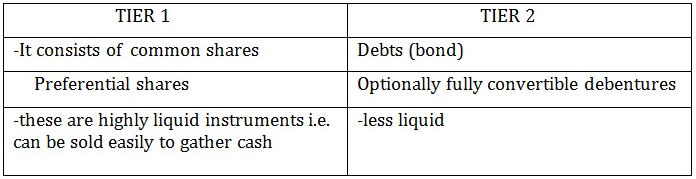
Capital is the money a bank receives in exchange for issuing shares. This capital is further classified into two – Tier 1 and Tier 2 capital.
Out of the 9% (of RWA) capital adequacy requirement, 7%(of RWA) has to be met by Tier 1 capital while the remaining 2%(of RWA) by Tier 2 capital.
Risk weighted assets- Every bank assigns its assets some weight-age based on the risk involved.Thus apply a weight percentage to each of its assets.
For example–
Lets say a bank lends Rs 100 to a person for home loan and Rs 100 to a person to start a new company.
Bank's total asset = Rs 100 + Rs 100 = Rs 200
Let's imagine home loan has high probability of being repaid than the loan to person to start a company.
i.e. Risk Weight of Home Loan = 50% and Risk Weight of loan for company = 90%
Risk Weighted Assets of Bank = 50% of 100 + 90% of 100 = 50 + 90 = Rs. 140. So out of total assets worth Rs. 200, Rs. 140 are risk weighted assets.
Bank need 9% of RWA as Capital.
Bank need 9% of 140 = Rs. 12.6 as Capital.
Means, out of Rs. 200 that a bank lends, Rs. 12.6 must be funded with Capital. Rest, Rs. 187.4 can be from the money that bank borrowed.
Secondly it also introduces the concept of leverage ratio, it measures the ratio of banks total assets to bank’s capital. Under the new set of guidelines, RBI has set the leverage ratio at 4.5% (3% under Basel III).
Leverage Ratio = Capital/Total Asset
Concept of leverage – for e.g.
If you have Rs. 100 and you invest them and earns a profit of 10% i.e. you have profit of Rs. 10 on Rs. 100. This is called non leverage profit.
Now again you have Rs. 100 and you borrow Rs. 400 and invest Rs. 500, earns a profit of 10% i.e. you earn Rs. 50 on your Rs. 100. This is called leverage profit.
With Higher leverage, Bank's Profit/Loss = Higher = Higher Risk also!
So now leverage ratio of 4.5% means for every Rs bank funds itself with, it can lend up to 22.22 Rs.
Challenges For It's Implementation In India
1. Capital- Since nearly 2.4 lakh crore rupees are required for its implementation in India.
2. Liquidity- During the global crisis 2008, the apparently strong banks of the world ran into difficulties when the inter bank wholesale funding market witnessed a seizure. Thus in Indian context, it would mean an additional burden of maintaining liquidity along with the SLR requirement.
3. Technology- BCBS is in the process of making significant changes in standard approach for computing RWAs for all three risk areas. Banks may need to upgrade their systems and processes to be able to compute capital requirements based on revised standard approach.
4. Skill development- Implementation of the new capital accord requires higher specialized skills in banks.
5. Governance- One can have the capital, the liquid assets and the infrastructure. But corporate governance will be the deciding factor in the ability of a bank to meet the challenges. Strong capital gives financial strength, it cannot assure good performance unless backed by good corporate governance.
Steps Taken by Government
(i) GOI has allowed banks to access markets to raise capital while maintaining a minimum 52% shareholding.
(ii) Govt. also launched a scheme called INDRADHANUSH to revamp PSBs. This scheme seeks to improve the efficiency and functioning of banks thereby reducing the bad assets. And also plans to infuse Rs 70,000 crore in the banking system over next 5 years.
In this regard government also announced two banks as DSIBs(Domestic Systemically Important Banks) i.e. SBI and ICICI, based on the criteria of size, interconnectedness, complexity and substitutability.
Note: According to new Basel-III norms, which kick in from March 2019,Indian banks need to maintain a minimum capital adequacy ratio (CAR) of 9 per cent (7 % for Tier I + 2% on Tier II Capital), in addition to a capital conservation buffer, which would be in the form of common equity at 2.5 per cent of the risk weighted assets

Friday, 3 March 2017

Money Transfer Service Scheme (MTSS)

Money Transfer Service Scheme (MTSS) is a quick and easy way of transferring personal remittances from abroad to beneficiaries in India. Only inward personal remittances into India such as remittances towards family maintenance and remittances favouring foreign tourists visiting India are permissible. No outward remittance from India is permissible under MTSS. The system envisages a tie-up between reputed money transfer companies abroad known as Overseas Principals and agents in India known as Indian Agents who would disburse funds to beneficiaries in India at ongoing exchange rates. The Indian Agents can in turn also appoint sub-agents to expand their network. The Indian Agent is not allowed to remit any amount to the Overseas Principal. Under MTSS the remitters and the beneficiaries are individuals only. 

Tuesday, 31 January 2017

Limits on Cash withdrawals from Bank accounts and ATMs - Restoration of status quo ante

Limits on Cash withdrawals from Bank accounts and ATMs - Restoration of status quo ante
Please refer to our circular DCM (Plg) No.1226/10.27.00/2016-17 dated November 08, 2016 placing limits on Cash withdrawals from bank accounts and ATMs in the wake of withdrawal of Legal Tender Character of Specified Bank Notes (SBN) and subsequent circulars DCM (Plg) Nos.1256, 1274, 1317, 1437, 2142 and 2559 dated November 11, 14, 21, 28, December 30, 2016 and January 16, 2017 respectively, providing for relief and relaxations therefrom.
2. On a review of the pace of remonitisation, it has been decided to partially restore status quo ante as under:
  1. Limits placed vide the circulars cited above on cash withdrawals from Current accounts/ Cash credit accounts/ Overdraft accounts stand withdrawn with immediate effect.
  2. The limits on Savings Bank accounts will continue for the present and are under consideration for withdrawal in the near future.
  3. Limits vide the circulars cited above placed on cash withdrawals from ATMs stand withdrawn from February 01, 2017. However, banks may, at their discretion, have their own operating limits as was the case before November 8, 2016, subject to 2 (ii) above.

Tuesday, 17 January 2017

Evidence of Import under Import Data Processing and Monitoring System (IDPMS)-Revised Instructions

1. FED Master Direction No. 17 dated January 1, 2016 on Import of Goods and Services and A.P. (DIR Series) Circular No. 9 dated August 24, 2000 which outlines the procedure, mode/manner of payment for imports and submission of related returns. Within the contours of the extant instructions on import of goods, specific attention is invited to the directions on Obligation of Purchaser of Foreign Exchange and submission of document as Evidence of Import.
2. Bill of Entry (BoE) data is received in IDPMS from Customs Department for EDI ports and from NSDL for SEZ on daily basis. BoE data for non-EDI ports are entered by AD Category – I bank of the importer on receipt of BoE (importer’s copy) and then the bank uploads the data in IDPMS through “Manual BOE reporting” process. In order to enhance ease of doing business and reduce transaction costs, it has been decided to discontinue submission of hardcopy of Evidence of Import documents i.e. BoE, with effect from December 01, 2016, as it is available in IDPMS. The revised procedures are as set out below:
i. AD Category – I bank will enter BoE details (BoE number, port code and date) as received from the importer and download the BoE message data from “BOE Master” in IDPMS. Thereafter, match and settle the BoE data with Outward Remittance Message (ORM) associated with the payment for import as per the message format “BOE Settlement” in IDPMS. Multiple ORMs can be settled against single BoE and also multiple BoE(s) can be settled against one ORM.
ii. In respect of imports on ‘Delivery against Acceptance’ basis, on request of importer, AD Category – I bank shall verify the evidence of import from IDPMS at the time of effecting remittance of import bill.
iii. On settlement of ORM with evidence of import AD Category – I bank shall in all cases issue an acknowledgement slip to the importer containing the following particulars:
  1. importer's full name and address with code number ;
  2. number and date of BoE and the amount of import; and
  3. a recap advice on number and amount of BoE and ORM not settled for the importer.
iv. The importer needs to preserve the printed ‘Importer copy’ of BoE as evidence of import and acknowledgement slip for future use.
3. The extant instructions and guidelines for Evidence of Import in Lieu of Bill of Entry will apply mutatis mutandis. The evidence of import in lieu of BoE in permitted/approved conditions will be created and uploaded by AD Category – I bank of the importer in the form of BoE data as per message format “Manual BOE reporting” in IDPMS.
4. Follow-up for Evidence of Import : AD Category – I banks shall continue to follow up for outward remittance made for import (i.e. unsettled ORM) in terms of extant guidelines and instructions on the subject. In cases where relevant evidence of import data is not available in IDPMS on due dates against the ORM, AD Category – I bank shall follow up with the importer for submission of documentary evidence of import. Similarly, if BoE data is not settled against ORM within the prescribed period AD Category – I banks shall follow up with the importer in terms of extant instructions.
5. Verification and Preservation: Internal inspectors and IS auditors (including external auditors appointed by AD Category – I bank) should carry out verification and IS audit and assurance of the “BOE Settlement” process in IDPMS. Data and process followed by AD Category –I bank for “BOE Settlement” should be preserved in terms of the guidelines under Cyber Security Framework in the bank. However, in respect of cases which are under investigation by investigating agencies, the data, process and/or documents may be destroyed only after obtaining clearance from the investigating agency concerned.

Enhancement of withdrawal limits from ATMs and Current Accounts

Enhancement of withdrawal limits from ATMs and Current Accounts

1. On a review of limits placed on withdrawals from ATMs and current accounts, it has been decided to enhance the same, with immediate effect as under:
(i) The limit on withdrawals from ATMs has been enhanced from the current limit of ₹ 4,500/- to ₹ 10,000/- per day per card (It will be operative within the existing overall weekly limit).
(ii) The limit on withdrawal from current accounts has been enhanced from the current limit of ₹ 50,000/- per week to ₹ 1,00,000/- per week and it extends to overdraft and cash credit accounts also.
2. There are no changes in the other conditions.

Thursday, 5 January 2017

(Updated as on January 04, 2017) Withdrawal of Legal Tender Character of the Old Bank Notes in the denominations of ₹ 500 and ₹ 1000

Withdrawal of Legal Tender Character of the Old Bank Notes in the denominations of ₹ 500 and ₹ 1000 and The Specified Bank Notes (Cessation of Liabilities) Ordinance 2016
(Updated as on January 04, 2017)
1. What is the Specified Bank Notes (Cessation of Liabilities) Ordinance 2016?
The Specified Bank Notes (Cessation of Liabilities) Ordinance 2016 has been promulgated by the President of India (GoI Ordinance No. 10 of 2016 dated December 30, 2016) to provide for cessation of liabilities on the Specified Banknotes and for connected/incidental matters and comes into effect from December 31, 2016. In terms of this ordinance, with effect from December 31, 2016, the Specified Bank Notes shall cease to be the liabilities of the Reserve Bank of India and shall cease to have the guarantee of the Central Government.
A grace period has been provided during which the Specified Bank Notes can be deposited at five RBI Offices (Mumbai, New Delhi, Chennai, Kolkata, and Nagpur) in accordance with this Ordinance by Indian citizens who make a declaration that they were outside India between November 9 and December 30, 2016, subject to conditions or any class of persons for reasons that may be specified by notification by the Central Government.
The Reserve Bank, if satisfied after making the necessary verifications, that the reasons for failure to deposit the notes till December 30, 2016 are genuine, will credit the value of notes in the KYC (Know Your Customer) compliant bank account of the tenderer.
Holding the specified banknotes (SBNs) for the purpose of deposit by Resident Indian citizens who were abroad during November 9, 2016 to December 30, 2016 and Non Resident Indian citizens who were abroad during November 9, 2016 to December 30, 2016 is permissible during grace period. With effect from January 2, 2017 Resident Indian citizens who were abroad during November 9, 2016 to December 30, 2016 can avail this facility upto March 31, 2017 and Non Resident Indian citizens who were abroad during November 9, 2016 to December 30, 2016 can avail this facility upto June 30, 2017. While there is no monetary limit for exchange for the eligible Resident Indians, the limit for NRIs will be as per the relevant FEMA Regulations. In terms of Section 6 of the Ordinance, whoever knowingly or wilfully makes any false declaration shall be punishable with a fine which may extend to 50,000 INR or five times the amount of the face value of the SBNs tendered whichever is higher. Any person aggrieved by the refusal of the Reserve Bank to credit the value of notes as mentioned above may make a representation to the Central Board of the Reserve Bank within 14 days of the communication of such refusal to him/her.
In terms of Section 5 of the Ordinance, from December 31, 2016 no person shall knowingly or voluntarily hold, transfer or receive any specified banknotes. After the expiry of grace period, holding of not more than 10 notes in total, irrespective of denomination or not more than 25 notes for the purpose of study/ research/ numismatics is permitted. In terms of Section 7, contravention of Section 5 shall be punishable with fine which may extend upto 10,000 INR or five times the face value of the SBNs involved in the contravention, whichever is higher.
In case the contravention/default in terms of Sections 6 and 7 is by a company, every person who was in charge of and responsible to the company at the time of contravention/ default shall deemed to be guilty and will be liable to be proceeded against and punished. If the offence is proved to be attributable to the conduct by any director/manager/secretary/officer/employee of the company, such person shall also be deemed to be guilty of the offence and will be liable to be proceeded against and punished accordingly.
2. How can NRIs and the Indian citizens who were abroad exchange the SBNs?
In terms of Paragraph 4.1 of the GoI Ordinance No. 10 of 2016 dated December 31, 2016 on “The Specified Bank Notes (Cessation of Liabilities), a facility for exchange of SBNs is made available for the resident and non-resident citizens who could not avail the facility from November 10 to December 30, 2016 on account of their absence from India during the aforementioned period. The facility will remain open for residents from January 2, 2017 to March 31, 2017 and for NRIs from January 2, 2017 to June 30, 2017 at five Reserve Bank offices at Mumbai, New Delhi, Chennai, Kolkata, and Nagpur.
The facility can be availed only in individual capacity and only on one occasion during the period. No third party tender is permissible under the facility.
This facility will not be available for Indian citizens resident in Nepal, Bhutan, Pakistan and Bangladesh.
3. Is the facility for exchange of SBNs by NRIs available outside India?
No. For NRIs the facility is available from January 2, 2017 to June 30, 2017 at five Reserve Bank offices at Mumbai, New Delhi, Chennai, Kolkata, and Nagpur. The limit of exchange for NRIs will be as per the relevant FEMA Regulations.
4. Is the facility available to Overseas Citizens of India (OCI)/Persons of Indian Origin (PIO)?
No, the facility is not available to OCIs/PIOs.
5. Is the facility available to resident Indians?
No, the facility is not available to all resident Indians, but only to those who were not in India during the period November 9, 2016 to December 30, 2016.
6. How much amount can I withdraw from an ATM?
The daily limit of withdrawal from ATMs has been increased (within the overall weekly limits specified) with effect from January 01, 2017, from the existing ₹ 2500/- to ₹ 4500/- per day per card. There is no change in weekly withdrawal limits.
7. What are the withdrawal limits for JDY account holders?
A JDY account holder can avail the deposit facility till December 30, 2016 subject to the caps and other laid down limits in accord with norms and procedures.
With a view to protecting the innocent farmers and rural account holders of PMJDY from activities of money launderers and legal consequences under the Benami Property Transaction & Money Laundering laws, it has been decided to place certain limits, as a matter of precaution, on the operations in the PMJDY accounts funded through deposits of Specified Bank Notes (SBNs) after November 09, 2016. As a temporary measure, the banks have been advised that:
(1) Fully KYC compliant account holders may be allowed to withdraw ₹ 10,000 from their account, in a month. The branch managers may allow further withdrawals beyond ₹10,000 within the current applicable limits only after ascertaining the genuineness of such withdrawals and duly documenting the same on the bank’s record.
(2) Limited or Non-KYC compliant account holders may be allowed to withdraw ₹ 5,000 per month from the amount deposited through SBNs after November 09, 2016 within the overall ceiling of ₹ 10,000.
8. Does the limit of ₹24,000 withdrawal apply to withdrawals from bank account of one bank from another bank?
These limits are not applicable to cash withdrawal from a bank account by one bank from another bank, Post Office, Money Changers operating at International airports and operators of White Label ATMs. The branches maintaining Currency Chests have been advised to accommodate the requests from other branches in their vicinity – linked or otherwise – for supply of cash.
9. Can I withdraw cash against cheque?
Yes, you can withdraw cash against withdrawal slip or cheque subject to a weekly limit of ₹ 24000 (including withdrawals from ATMs and over the counter) from the bank accounts.
Business entities having Current Accounts which are operational for last three months or more will be allowed to draw ₹ 50,000 per week. This can be done in a single transaction or multiple transactions. This facility has been extended to Overdraft and Cash Credit accounts and traders registered with the Agricultural Produce Market Committee (APMC) markets or mandis. Accordingly, holders of current/overdraft/cash credit accounts, which are operational for the last three months or more, may withdraw upto ₹ 50,000 in cash, in a week. Such withdrawals may be disbursed predominantly in ₹ 2,000 denomination bank notes. This enhanced limit for weekly withdrawal is not applicable for personal overdraft accounts. Farmers are allowed to draw upto ₹ 25,000 per week in cash from their loan (including Kisan Credit Card limit) or deposit accounts subject to their accounts being compliant with the extant KYC norms.
10. What is being done for the farmers?
Farmers are allowed to draw upto ₹ 25,000 per week in cash from their loan (including Kisan Credit Card limit) or deposit accounts subject to their accounts being compliant with the extant KYC norms.
Towards ensuring unhindered farming operations during the Rabi crop season, NABARD would be utilizing its own cash credit limits up to about ₹ 23,000 crore to enable the DCCBs to disburse the required crop loans to PACS and farmers. Banks with currency chests have been advised to ensure adequate cash supply to the DCCBs and RRBs. Adequate cash supply should also be ensured for rural branches of all commercial (including RRBs). Bank branches located in APMCs may also be given adequate cash to facilitate smooth procurement.

CONDITIONS FOR OPENING ACCOUNTS OF FOREIGN NATIONALS, STUDENTS AND NRI

ELIGIBILITY CONDITIONS FOR OPENING OF RESIDENT INDIAN OR NRI ACCOUNTS
Account TypeDomestic / Resident AccountsNon Resident Ordinary (NRO) AccountsNon Resident External (NRE) AccountsForeign Currency Non-resident (Bank) {FCNR (B)} Accounts
Residential Status
NRINot-permitted1Permitted2,7Permitted2Permitted2
PIONot-permitted1Permitted2,3,7Permitted2,3Permitted2,3
OCINot-permitted1Permitted2,3,7Permitted2,3Permitted2,3
Foreign Nationals on employment in IndiaPermitted3,4Not-permitted4Not-permittedNot-permitted
Foreign Students studying in IndiaNot-permittedPermitted3,5Not-permittedNot-permitted
Foreign Tourists on short visit to IndiaNot-permittedPermitted3,6Not-permittedNot-permitted
1 However a joint account with Resident Indian (RI) who is a close relative can be opened subject to following conditions:
  • Mode of operation permitted is 'Either or Survivor' only
  • The RI will be the primary/first account holder in the joint account and NRI (PIO / OCI) will be the second applicant
2 A joint account with Resident Indian (RI) who is a close relative can also be opened subject to following conditions:
  • Mode of operation permitted is 'Former (NRI) or Survivor' only
  • The NRI (PIO / OCI) will be the primary/first account holder in the joint account and RI will be the second applicant
3 Following conditions applicable:
  • Pakistani National will require a prior approval from RBI before opening the account.
  • Bangladesh National to have a valid visa and residential permit issued by Foreigner Registration Office (FRO) / Foreigner Regional Registration Office (FRRO) concerned.
4 Foreign nationals who come to India on employment and on leaving the India can convert their Domestic account to NRO account, to enable them to receive their legitimate dues subject to certain conditions. But, continuation of account beyond 6 months will require RBI’s approval.
5 NRO account be opened for Foreign Students studying in India on the basis of his/her passport (with appropriate visa & immigration endorsement) which contains the proof of identity and address in the home country along with a photograph and a letter offering admission from the educational institution, subject to following:
  1. Within a period of 30 days of opening the account, the foreign student should submit to the branch where the account is opened, a valid address proof giving local address, in the form of a rent agreement or a letter from the educational institution as a proof of living in a facility provided by the educational institution. Banks should not insist on the landlord visiting the branch for verification of rent documents and alternative means of verification of local address may be adopted by banks.
  2. During the 30 days period, the account should be operated with a condition of allowing foreign remittances not exceeding USD 1,000 into the account and a cap of monthly withdrawal to Rs. 50,000/-, pending verification of address.
  3. On submission of the proof of current address, the account would be treated as a normal NRO account, and will be operated in terms of extant instructions.
6 Continuation of account beyond 6 months will require RBI’s approval.
7 NRIs (including PIO / OCI) residing in Nepal or Bhutan are not permitted to open NRO account.

*Sources RBI/sbi and other bank sights.

Exchange facility to foreign citizens


1. A.P. (DIR Series) Circular No. 20 dated November 25, 2016 had permitting foreign citizens to exchange foreign exchange for Indian currency notes up to a limit of ₹ 5000/- per week till December 15, 2016 and and was extended up to December 31, 2016 vide A.P. (DIR Series) Circular No. 22 dated December 16, 2016.

2. On a review it has been decided that the instructions contained in the A.P. (DIR Series) Circular No. 20 dated November 25, 2016 shall continue to be in force till January 31, 2017.

Thursday, 22 December 2016

FREQUENTLY ASKED QUESTIONS-Withdrawal of old Bank Notes in the denominations of ₹ 500/- and ₹ 1000/- (Updated as on December 22, 2016)

FREQUENTLY ASKED QUESTIONS

Withdrawal of Legal Tender Character of the old Bank Notes in the denominations of ₹ 500/- and ₹ 1000/- (Updated as on December 22, 2016)
(Updated as on December 22, 2016)
1. Why is this scheme introduced?
The incidence of fake Indian currency notes in higher denomination has increased. For ordinary persons, the fake notes look similar to genuine notes, even though no security feature has been copied. The fake notes are used for antinational and illegal activities. High denomination notes have been misused by terrorists and for hoarding black money. India remains a cash based economy hence the circulation of Fake Indian Currency Notes continues to be a menace. In order to contain the rising incidence of fake notes and black money, the scheme to withdraw has been introduced.
2. What is this scheme?
The legal tender character of the existing bank notes in denominations of ₹ 500 and ₹ 1000 issued by the Reserve bank of India till November 8, 2016 (hereinafter referred to as Specified Bank Notes) stands withdrawn. In consequence thereof these Bank Notes cannot be used for transacting business and/or store of value for future usage. The Specified Bank Notes can be exchanged for value at any of the 19 offices of the Reserve Bank of India and deposited at any of the bank branches of commercial banks/ Regional Rural Banks/ Co-operative banks (only Urban Co-operative Banks and State Co-operative Banks) or at any Head Post Office or Sub-Post Office.
District Central Cooperative Banks (DCCBs) can allow their existing customers to withdraw money from their accounts upto ₹ 24,000 per week. No exchange facility against the specified bank notes (₹ 500 and ₹ 1000) or deposit of such notes should be entertained by DCCB’s. The Reserve Bank has accordingly advised all banks to permit withdrawal of cash by DCCBs from their accounts based on need.
3. Does the scheme apply to pre 2005 banknotes of ₹ 500 and ₹ 1000?
Yes, specified banknotes (SBN) include pre 2005 banknotes in the denominations of ₹ 500 and ₹ 1000. Banks should accept deposits of pre-2005 bank notes in the denominations of ₹ 500 and ₹ 1000 under the scheme. However, these notes can be exchanged at RBI Offices only.
4. How much value will I get?
You will get value for the entire volume of notes tendered at the bank branches / RBI offices.
5. Can I get all in cash?
The Scheme does not provide for it, given its objectives. You can use balances in bank accounts to pay for other requirements by cheque or through electronic means of payments such as Internet banking, mobile wallets, IMPS, credit/debit cards etc.
6. Can I get cash in exchange for specified banknotes over the bank counter?
No. Over the counter exchange (in cash) of SBNs is not permitted from November 25, 2016. Members of public who approach the banks for over the counter exchange of SBN are encouraged to deposit SBNs into their bank accounts. Banks have been advised to facilitate opening of new accounts for unbanked people.
7. What if I don’t have any bank account?
You can always open a bank account by approaching a bank branch with necessary documents required for fulfilling the KYC requirements.
8. What if, if I have only JDY account?
A JDY account holder can avail the deposit facility subject to the caps and other laid down limits in accord with norms and procedures.
With a view to protect the innocent farmers and rural account holders of PMJDY from activities of money launders and legal consequences under the Benami Property Transaction & Money Laundering laws, it has been decided to place certain limits, as a matter of precaution, on the operations in the PMJDY accounts funded through deposits of Specified Bank Notes (SBNs) after November 09, 2016. As a temporary measure, the banks have been advised that:
(1) Fully KYC complaint account holders may be allowed to withdraw ₹ 10,000/- from their account, in a month. The branch managers may allow further withdrawals beyond ₹ 10,000 within the current applicable limits only after ascertaining the genuineness of such withdrawals and duly documenting the same on bank’s record.
(2) Limited or Non KYC compliant account holders may be allowed to withdraw ₹ 5,000 per month from the amount deposited through SBNs after November 09, 2016 within the overall ceiling of ₹ 10,000.
9. Where can I go to exchange the notes?
The exchange facility has been stopped at bank branches with effect from November 25, 2016.
10. Should I go to bank personally for deposit or can I send the notes through my representative?
Personal visit to the branch is preferable. In case it is not possible for you to visit the branch you may send your representative with an express mandate i.e. a written authorisation. The representative should produce authority letter and his / her valid identity proof while tendering the notes.
In case you want to go to a branch of any other bank where you are not maintaining an account, you will have to furnish valid identity proof and bank account details required for electronic fund transfer to your account.
11. Can I withdraw from ATM?
The ATMs are progressively getting recalibrated. As and when they are recalibrated, the cash limit of such ATMs will stand enhanced to ₹ 2500/- per day. This will enable dispensing of lower denomination currency notes for about ₹ 500/- per withdrawal. Other ATMs which are yet to be recalibrated, will continue to dispense ₹ 2000/- till they are recalibrated.
Banks have also been advised to increase the Business Correspondents’ limit of dispensing cash to ₹ 2500/- for withdrawal from bank accounts.
12. What will be the levied ATM charges?
It has been decided that banks shall waive levy of ATM charges for all transactions (inclusive of both financial and non-financial transactions) by savings bank customers done at their own banks’ ATMs as well as at other banks’ ATMs, irrespective of the number of transactions during the month. This waiver is applicable on transactions done at ATMs from November 10, 2016 till December 30, 2016, subject to review.
13. Does the limit of ₹ 24000 withdrawal apply to withdrawals from bank account of one bank from another bank?
These limits are not applicable to cash withdrawal from a bank account by one bank from another bank, Post Office, Money changers operating at International airports and operators of White Label ATMs. The branches maintaining Currency Chests have been advised to accommodate the requests from other branches in their vicinity – linked or otherwise – for supply of cash.
14. Can I withdraw cash against cheque?
Yes, you can withdraw cash against withdrawal slip or cheque subject to a weekly limit of ₹ 24000/- (including withdrawals from ATMs and over the counter) from the bank accounts.
Business entities having Current Accounts which are operational for last three months or more will be allowed to draw ₹ 50,000/-per week. This can be done in a single transaction or multiple transactions. This facility has been extended to Overdraft and Cash Credit accounts and traders registered with the Agricultural Produce Market Committee (APMC) markets or mandis. Accordingly, holders of current / overdraft / cash credit accounts, which are operational for the last three months or more, may withdraw upto ₹ 50000 in cash, in a week. Such withdrawals may be disbursed predominantly in ₹ 2000 denomination bank notes. This enhanced limit for weekly withdrawal is not applicable for personal overdraft accounts. Farmers are allowed to draw upto ₹ 25000/- per week in cash from their loan (including Kisan Credit Card limit) or deposit accounts subject to their accounts being compliant with the extant KYC norms.
15. Can I withdraw a higher amount for the purpose of my ward’s wedding?
With a view to enable members of the public to perform and celebrate weddings of their wards it has been decided to allow a cash withdrawal of maximum ₹ 250000/- from their bank deposit accounts till December 30, 2016 out of the balances at credit in the account as at close of business on November 08, 2016 to meet wedding related expenses. This is subject to the following conditions:
i. Withdrawals are permitted only from fully KYC compliant accounts.
ii. The amounts can be withdrawn only if the date of marriage is on or before December 30, 2016.
iii. Withdrawals can be made by either of the parents or the person getting married. (Only one of them will be permitted to withdraw).
iv. Since the amount proposed to be withdrawn is meant to be used for cash disbursements, it has to be established that the persons for whom the payment is proposed to be made do not have a bank account.
v. The application for withdrawal shall be accompanied by following documents:
  1. Evidence of the wedding, including the invitation card, copies of receipts for advance payments already made, such as Marriage hall booking, advance payments to caterers, etc.
  2. A detailed list of persons to whom the cash withdrawn is proposed to be paid, together with a declaration from such persons that they do not have a bank account, where the amount proposed to be paid is ₹ 10,000/- or more. The list should indicate the purpose for which the proposed payments are being made.
Banks may keep a proper record of the evidence and produce them for verification by the authorities in case of need. The scheme will be reviewed based on authenticity/ bona fide use thereof. Yet, banks should encourage families to incur wedding expenses through non-cash means viz. cheques /drafts, credit/debit cards, prepaid cards, mobile transfers, internet banking channels, NEFT/RTGS, etc. Therefore, members of the public should be advised, while granting cash withdrawals, to use cash to meet expenses which have to be met only through cash mode.
16. What is being done for the farmers?
Farmers are allowed to draw upto ₹ 25000/- per week in cash from their loan (including Kisan Credit Card limit) or deposit accounts subject to their accounts being compliant with the extant KYC norms. Specified banknotes in the denomination can be used for making payments towards purchase of seeds from the centres, units or outlets belonging to the Central or State Governments, Public Sector Undertakings, National or State Seeds Corporations, Central or State Agricultural Universities and the Indian Council of Agricultural Research, on production of proof of identity.
Towards ensuring unhindered farming operations during the Rabi crop season, NABARD would be utilizing its own cash credit limits up to about ₹ 23,000 crore to enable the DCCBs to disburse the required crop loans to PACS and farmers. Banks with currency chests have been advised to ensure adequate cash supply to the DCCBs and RRBs. Adequate cash supply should also be ensured for rural branches of all commercial (including RRBs). Bank branches located in APMCs may also be given adequate cash to facilitate smooth procurement.
17. Can I deposit Specified Bank Notes through ATMs, Cash Deposit Machine, cash Recycler and bank branches multiple times?
Yes, Specified Bank Notes can be deposited in Cash Deposits machines / Cash Recyclers or at bank branches more than once till December 30, 2016. At bank branches, customers should use separate pay-in-slips for depositing specified bank notes and other legal tender bank notes.(If a depositor has a mixed bunch of SBN and legal tender notes, he has to segregate them and submit two separate Pay-in slips).
18. Can I make use of electronic (NEFT/RTGS /IMPS/ Internet Banking / Mobile banking etc.) mode?
You can use NEFT/RTGS/IMPS/Internet Banking/Mobile Banking or any other electronic/ non-cash mode of payment. In order to meet the transactional needs of the public through digital means, additional measures have been introduce by way of special dispensation for small merchants and enhancement in limits for semi-closed Prepaid Payment Instruments (PPIs).
PPIs issuers can issue PPIs to such merchants. While balance in such PPIs cannot exceed ₹ 20,000/- at any point of time, the merchants can transfer funds from such PPIs to their own linked bank accounts upto ₹ 50,000/- per month, without any limit per transaction. Merchants only need to provide a self-declaration in respect of their status and details of their bank account.
The limit of semi-closed PPIs issued with minimum details has been enhanced to ₹ 20,000/- from the existing ₹ 10,000/-. The total value of reloads during any given month has also been enhanced to ₹ 20,000/-.
Extant instructions for other categories of PPIs remain unchanged. Full KYC PPIs with balance upto ₹ 1,00,000/- can continue to be made available by authorised PPI issuers. The above measures will be effective from November 21, 2016 till December 30, 2016, subject to review.
Relaxation in Additional Factor of Authentication (AFA) for payments upto ₹ 2000/- for card network provided authentication solutions has been permitted for the Card Not Present (CNP) transactions. For details please refer RBI DPSS circular dated December 6, 2016.
19. I am right now not in India, what should I do?
If you have Specified banknotes in India, you may authorise in writing enabling another person in India to deposit the notes into your bank account. The person so authorised has to come to the bank branch with the Specified banknotes, the authority letter given by you and a valid identity proof (Valid Identity proof is any of the following: Aadhaar Card, Driving License, Voter ID Card, Pass Port, NREGA Card, PAN Card, Identity Card Issued by Government Department, Public Sector Unit to its Staff)
20. I am an NRI and hold NRO account, can the exchange value be deposited in my account?
Yes, you can deposit the Specified banknotes to your NRO account.
21. I am a foreign tourist, how much Indian currency can I get after the announcement of withdrawal of legal tender status for specified banknotes?
Foreign citizens will be permitted to exchange foreign currency up to ₹ 5000 per week. Necessary entry to this effect will be made in their passports.
22. I have emergency needs of cash (hospitalisation, travel, life saving medicines) then what I should do?
Exemptions for the use of specified banknotes have been discontinued with effect from December 16, 2016
23. Can I deposit the Specified banknotes to my account?
Deposits of Specified bank Notes into all types of deposit/loan accounts of Public Sector Banks/ Private Sector Banks / Foreign Banks/Regional Rural Banks / Urban Cooperative Banks/ State Cooperative Banks is allowed subject to CTR/STR reporting. Certain restrictions have been imposed on deposits of SBNs into non KYC compliant bank accounts as indicated below:
Tenders of SBNs in excess of ₹ 5000 into a non KYC compliant bank account will be received for credit only once during the remaining period till December 30, 2016. The credit in such cases shall be afforded only after questioning tenderer, on record, in the presence of at least two officials of the bank, as to why this could not be deposited earlier and receiving a satisfactory explanation. The explanation will be kept on record to facilitate an audit trail at a later stage.
Even when tenders smaller than ₹ 5000 are made in a non KYC compliant bank account and such tenders taken together on cumulative basis exceed ₹ 5000 they may be subject to the procedure to be followed in case of tenders above ₹ 5000, with no more tenders being allowed thereafter until December 30, 2016.
The above restrictions shall not apply to tenders of SBNs for deposits in KYC compliant account and deposits under the Taxation and Investment Regime for the Pradhan Mantri Garib Kalyan Yojana, 2016
The equivalent value of specified bank notes tendered will be credited to an account maintained by the tenderer at any bank in accordance with standard banking procedure and on production of valid proof of Identity.
The equivalent value of specified bank notes tendered may be credited to a third party account, provided specific authorisation therefor accorded by the third party is presented to the bank, following standard banking procedure and on production of valid proof of identity of the person actually tendering, as indicated in Annex-5 of our circular DCM (Plg) No.1226/10.27.00/2016-17 dated November 08, 2016
Anybody depositing more than ₹ 50,000/- in cash in their bank account has to submit a copy of the PAN card in case the bank account is not seeded with PAN.
24. Can I deposit SBN to Small Savings Scheme?
Government of India has decided that subscribers of Small Savings Schemes may not be allowed to deposit SBNs in Small Savings Schemes. Banks have been advised not to accept SBNs for deposits in Small Saving Schemes with immediate effect. However deposits into Post Office Savings account are permitted
25. What is proof of identity?
Valid Identity proof is any of the following: Aadhaar Card, Driving License, Voter ID Card, Pass Port, NREGA Card, PAN Card, Identity Card Issued by Government Department, Public Sector Unit to its Staff.
26. Where can I get more information on this scheme?
Further information is available on our website (www.rbi.org.in) and the website of the Government of India (www.finmin.nic.in)
27. What steps have been taken for queue management?
Banks have been advised to make arrangements for separate queues for Senior citizens and Divyang (disabled) persons. Similarly, separate queues should also be arranged for those who come to exchange SBN for cash and those who come to deposit into bank accounts.
The last date for submission of the annual life certificate for the government pensioners which is to be submitted in November every year has been extended upto January 15, 2017 to facilitate.
The Reserve Bank assures members of the public that enough cash in small denominations is also available at the Reserve Bank and banks. The Reserve Bank urges that public need not be anxious; need not come over to banks repeatedly to draw and hoard; Cash is available when they need it.
Also see:
28. If I have a problem, whom should I approach?
You may approach the control room of RBI by email or on Telephone Nos 022 22602201/022 22602944